

Part 6/6: [S8fe.ai’s Manifesto]
The global financial system was reshaped in 1944 at Bretton Woods, where world leaders aligned on rules to govern currencies, capital flows, and trade. Today, we face a similar turning point—except the currency is data, and the infrastructure is digital.
Just like gold once backed economic power, data now underpins strategic dominance. From generative AI to targeted advertising to predictive defense systems, whoever controls the flow and labeling of data holds the reins of economic and political leverage.
Example: The U.S. Chips Act and China’s Personal Information Protection Law are not just about tech—they’re about national control over digital pipelines and value chains.
But unlike Bretton Woods, there’s no global consensus or framework governing cross-border data transfers. Instead, we face fragmented regulation, a race to the bottom in compliance standards, and an everwidening digital divide. The result: countries rich in data are unable to extract fair value from its export, while dominant platforms continue to monetize user behavior with little accountability.
Example: In Africa, vast quantities of user data are extracted by global platforms, yet local cloud infrastructure remains underdeveloped, and tax revenues are negligible. The data economy is exporting wealth—not building it.
It’s time for a Data Bretton Woods—a globally coordinated framework
to define the rules of digital trade, enforce transparency, and introduce
digital tariffs that ensure shared prosperity and compliance.
Recommendation 1: Implementing “Data Customs” Infrastructure
Just like goods are declared and inspected at physical borders, data exports should undergo a digital customs process. This doesn’t mean slow bureaucratic hurdles, but rather automated, real-time validation systems that:
• Identify the nature and sensitivity of the data.
• Check whether it complies with the export rules of the originating country.
• Generate audit trails to prove compliance.
Companies that proactively adopt these digital customs mechanisms will be able to maintain seamless global data exchanges, while staying ahead of regulatory scrutiny.
It could be stored on public blockchain to ensure efficient unalterable data time stamping.
Recommendation 2: Data Labeling and Traceability Protocols
One of the biggest bottlenecks today is that organizations often lack clarity on what data they are transferring and what rules apply. By introducing standardized data labeling frameworks, every dataset can carry a “compliance passport” specifying:
• Its origin.
• The applicable regulations.
• Its permitted use and destinations.
• This protocol would enable trusted data exchanges across borders, much like the concept of “trusted trader” programs in international logistics.
Recommendation 3: Local Data Processing, Global Insight Exchange
Another pathway is decentralized data processing. Instead of transferring raw data, companies can process sensitive datasets within national borders and only share aggregated, anonymized insights internationally.
This “process locally, exchange globally” model would protect sovereignty while preserving the value of cross-border analytics and AI training.
Dubai’s Smart City infrastructure, for instance, mandates local processing for all citizen data but shares high-level mobility patterns and urban metrics with international partners for research and collaboration.
One innovative way to reconcile data sovereignty with the need for cross-border exchanges is to establish “Trusted Data Exchange Hubs” — neutral, high-security environments where data from multiple jurisdictions can be processed, validated, and exchanged under strict compliance protocols.
Abu Dhabi As Switzerland Of Data
Think of it as the “Switzerland of Data”: a place where nations agree to park sensitive data assets under mutually recognized governance frameworks, while retaining sovereignty and control over their usage.
A place like Abu Dhabi could play this role with:
• Low-cost, sustainable energy: Abu Dhabi’s investments in solar and green hydrogen make it an ideal location for energy-hungry data operations.
• Geopolitical neutrality & regulatory innovation: Positioned as a bridge between East and West, Abu Dhabi has the political capital to negotiate bilateral and multilateral data exchange agreements.
• World-class infrastructure: With advanced data centers (e.g., Khazna), high connectivity, and sovereign cloud strategies, it can guarantee physical and digital security at scale.
• Willingness to lead on standards: Similar to how Switzerland became the safe haven for global finance, Abu Dhabi could pioneer global data trust frameworks, creating a high-trust environment for cross-border data collaborations.
How It Would Work
• Data is processed or “cleansed” locally in its country of origin.
• Sensitive datasets are then transferred to the Abu Dhabi Data Hub, where pre-agreed compliance checks and labeling protocols are enforced.
• Only approved, traceable data assets are allowed to leave the hub for specific international usage.
• Governments and corporates retain sovereignty over their data assets while enabling frictionless global collaboration.
This model would support industries like AI training, financial services, life sciences, and global research, where cross-border data collaboration is essential but needs to happen within trusted and regulated environments.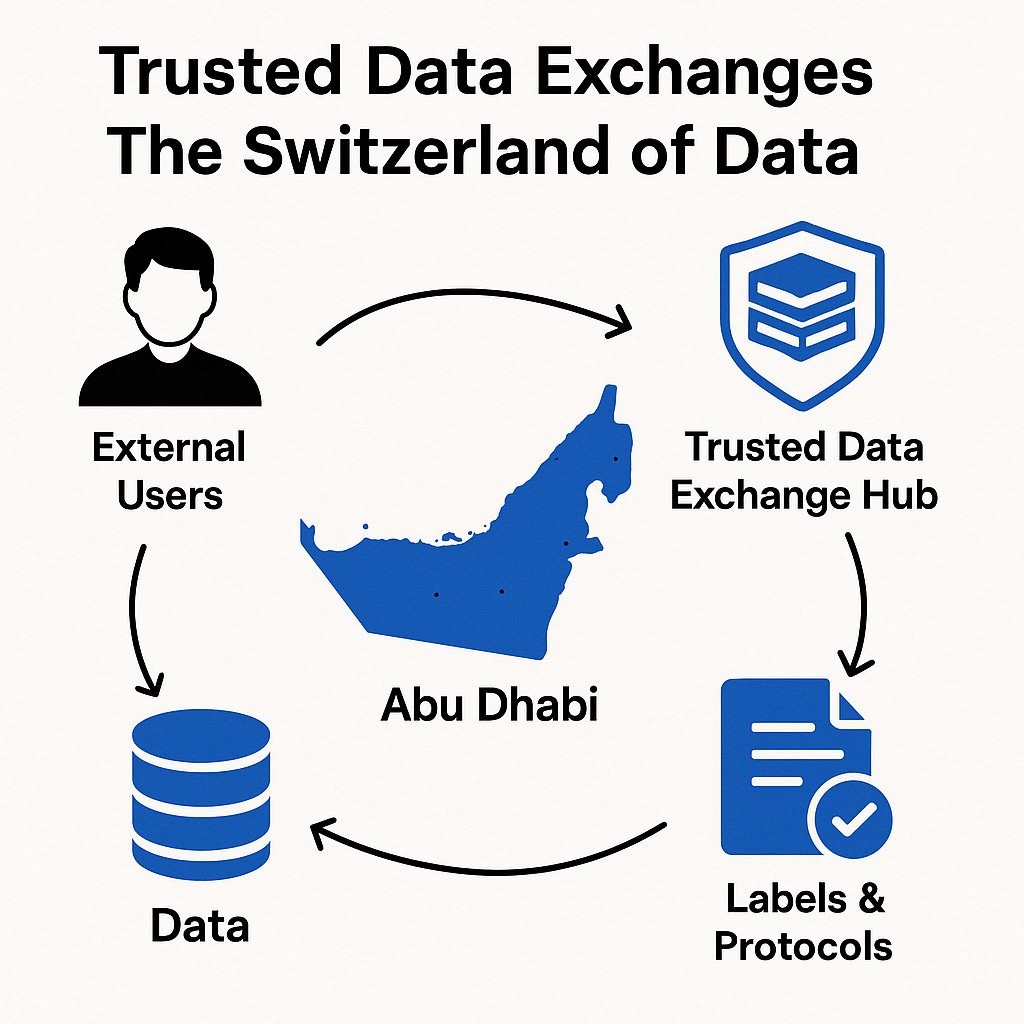
Why S8fe.ai is Key to This Vision
S8fe.ai could act as the compliance orchestrator within such Data Exchange Hubs — automating validation processes, maintaining transparent audit trails, and ensuring data exchanges respect every stakeholder’s sovereignty terms.
How S8fe.ai Makes This Operational
At S8fe.ai, we are building the compliance infrastructure that turns these principles into everyday business workflows:
• Automated data customs validation engines.
• Dynamic data labeling and classification systems.
• Compliance audit dashboards to streamline reporting.
Our mission is to ensure that respecting data sovereignty doesn’tbecome a bottleneck but a competitive advantage for organizations operating in a regulated digital economy.
This article marks the final chapter of S8fe.ai’s Manifesto. It is not just an ending, but an invitation.
We believe the data economy can no longer be treated as invisible infrastructure — it is the lifeblood of a new global order. Transparency, sovereignty, and accountability must shape the flows of information just as borders, tariffs, and treaties once shaped the flows of goods.
A new world is already emerging. One where data is recognized as an asset, taxed as a resource, and protected as a right. One where compliance is not a burden, but the foundation of trust. We hope these ideas push you to pause, rethink, and re-imagine.
Because the future of data is not written yet.