

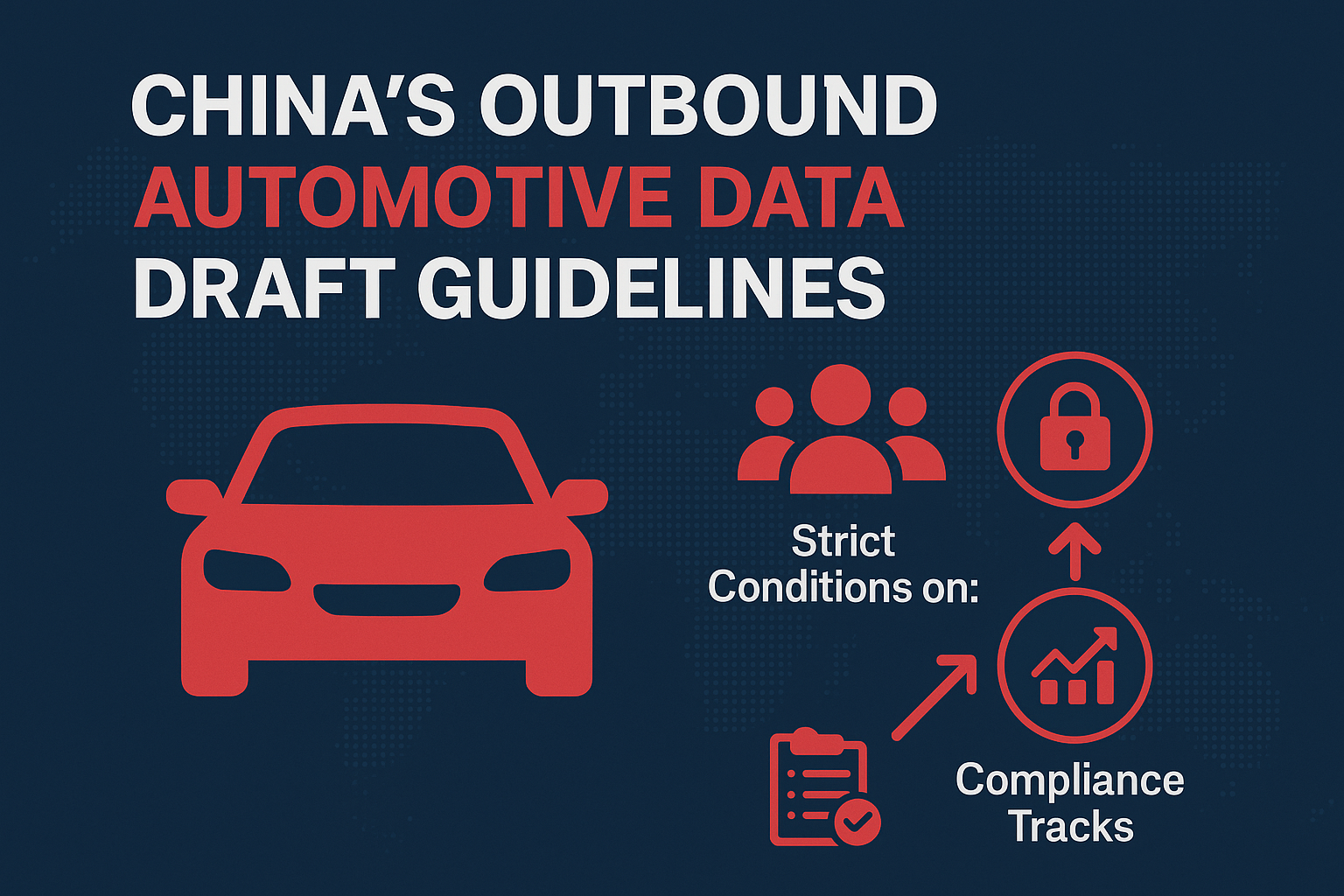
The Automotive Data Outbound Security Guidelines (2025 Edition) carry significant implications for any global automotive or mobility player operating in China.
Key Stakeholders:
This applies to OEMs, Tier 1 suppliers, telecom carriers, software platforms, and autonomous driving providers— anyone involved in collecting or processing vehicle-related data.
What’s at Stake?
The regulation introduces strict conditions on how two major types of data can be transferred or accessed across borders:
Personal Data – from customers, drivers, or employees.
Important Operational Data – such as:
- Real-time driving trajectories
- Sensor & camera data (faces, plates, environments)
- High-precision maps and algorithm training data
- EV charging locations and user consumption metrics
“Outbound transfer” now means more than just data export.
It includes any situation where foreign systems access or process Chinese data — even remotely.
Three Compliance Tracks
- Mandatory Security Assessments – for sensitive or large-volume transfers
- Standard Contracts / Certifications – for mid-level personal data flows
- Defined Exemptions – for cases like cross-border sales, HR processing, or recalls
Why Executives Should Care:
This draft outlines operational and strategic responsibilities:
- Appointing data security officers
- Establishing audit trails and internal approvals
- Retaining detailed logs for at least 3 years
- Ensuring encryption and recipient authentication
For global auto leaders, this isn’t just a legal shift — it’s a signal. Data governance is now core to market access, trust, and business continuity in China’s mobility landscape.
Now is the time to assess your exposure and align your data strategy.
Source: https://www.cac.gov.cn/2025-06/13/c_1751439043533847.htm