

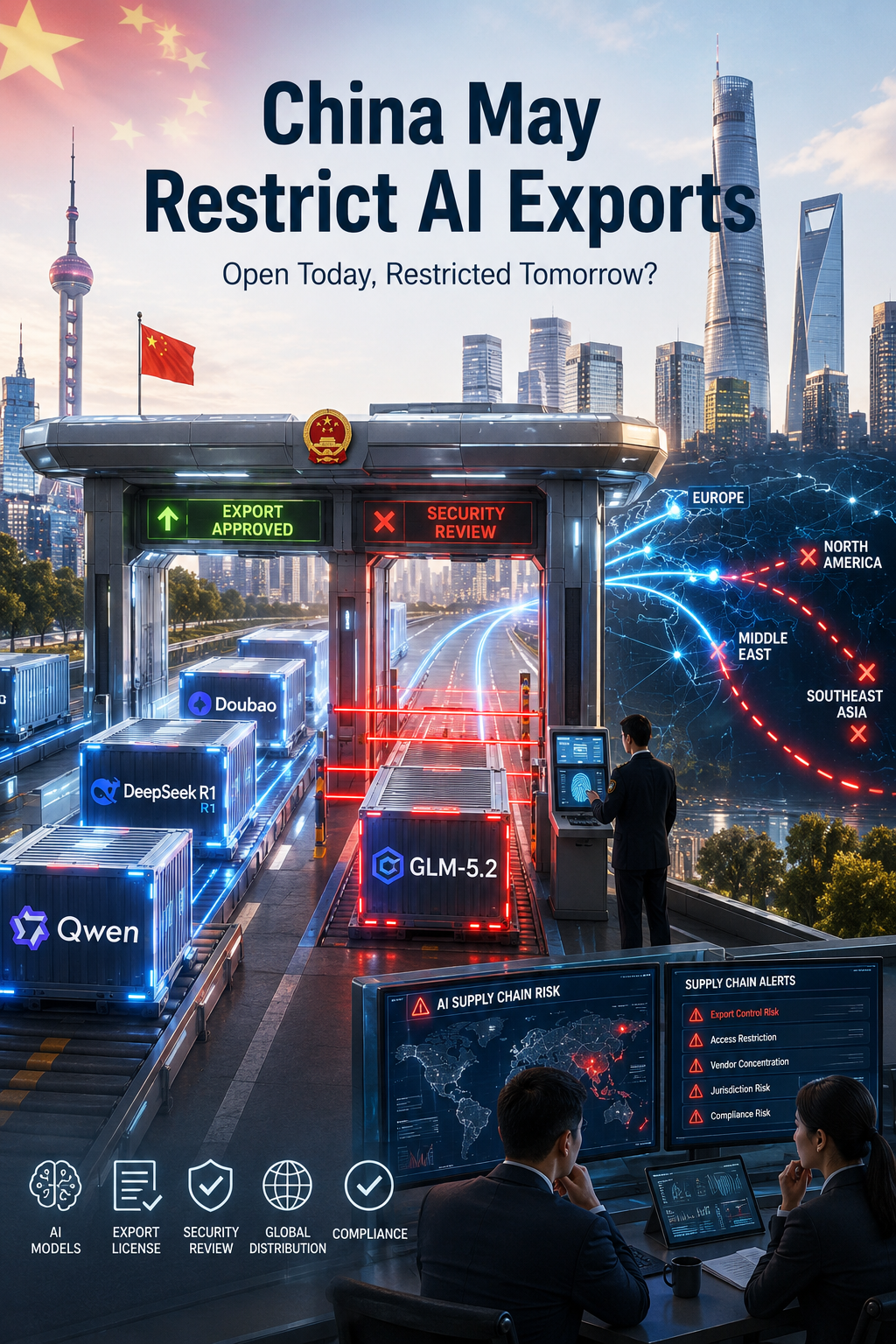
China’s Ministry of Commerce is holding talks with Alibaba, ByteDance, and Z.ai about restricting overseas access to the country’s most advanced AI models — including Qwen, Doubao, GLM-5.2, and DeepSeek R1.
Open-source was China’s global distribution strategy. DeepSeek and Qwen spread Chinese AI infrastructure across markets at near-zero cost, undercutting US labs on pricing and eroding their competitive moat. Now Beijing is considering curbing the very openness that made that expansion possible.
The proposed mechanism: a tiered regime. Basic open-source tools would require a simple filing. More capable models would face security reviews. Frontier models could be barred from public release or restricted to domestic use only. Officials also discussed making AI technology leaks prosecutable under national security law.
No formal regulations have been announced. No timeline has been set. But the consultations are expanding — a July 20 Financial Times report confirmed that MofCom is now consulting chipmakers alongside AI labs, with measures including expanded prohibited product lists and stricter licensing for technology transfers. China may soon impose the same kind of export controls on its own AI and semiconductor technologies that it has spent years resisting when applied by the US.
What this means for your compliance team:
→ If your organisation uses Chinese AI models — Qwen, DeepSeek, GLM-series — in production, you now face potential supply-chain disruption risk. Access that exists today may not exist tomorrow.
→ The restrictions could apply to both closed-source API access and open-weight model downloads. “Open source” does not guarantee continued availability.
→ Combined US-China AI export restrictions could fragment global model access. Organisations that standardised on a single provider — Western or Chinese — face concentration risk from both directions.
→ AI vendor due diligence must now include jurisdictional origin risk. The question is no longer just “which model is best?” — it’s “which model will I still be allowed to use in 12 months?”
→ The scope is expanding in real time. Initial consultations covered AI models; the latest reports include semiconductor technologies and anti-acquisition measures. Plan for the broadest version of these controls, not the narrowest.
At S8fe.ai, we help organisations map their data supply chains and assess jurisdictional risk — because when both superpowers start restricting AI model access, vendor neutrality becomes a compliance requirement, not a preference.
The bifurcation used to run in one direction. Now it runs in both.
Sources:
• https://finance.yahoo.com/technology/ai/articles/exclusive-beijing-looking-curbing-overseas-101644780.html
• https://fourweekmba.com/ai-china-ai-model-export-curbs-alibaba-bytedance-bifurcation/