

For organizations handling large-scale personal data, the compliance risk equation just changed dramatically.
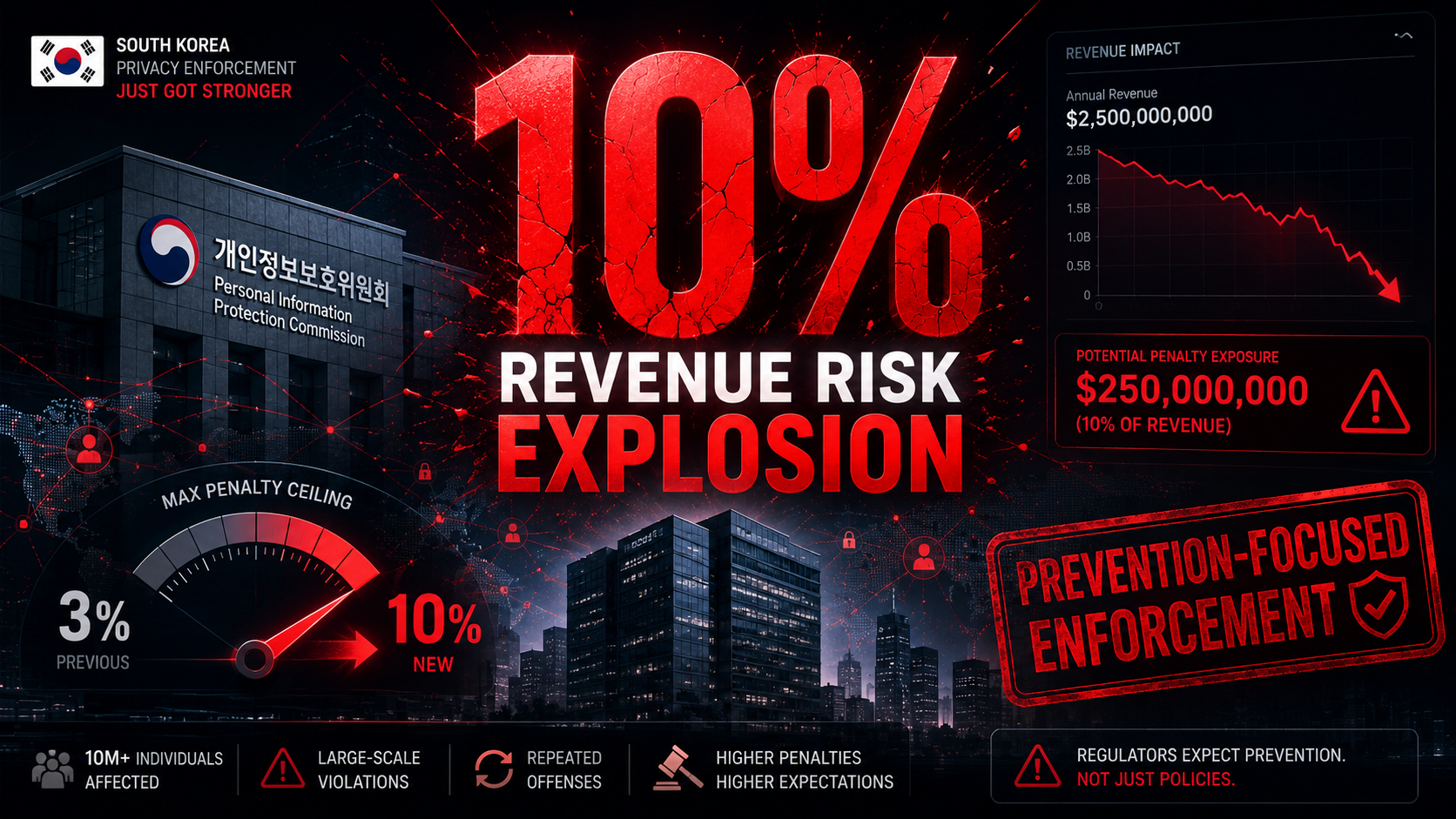
South Korea’s Personal Information Protection Commission (PIPC) announced a major enforcement shift focused on prevention-first compliance — while simultaneously increasing the maximum privacy penalty ceiling from 3% to 10% of revenue for serious or repeated violations impacting 10M+ individuals.
What Changed
• Maximum financial exposure more than tripled
• Enforcement now targets systemic compliance failures, not just isolated incidents
• Large-scale data handlers face heightened scrutiny for repeated violations
• Regulators are signaling that “reactive compliance” is no longer acceptable
Why This Matters
This is part of a broader global regulatory trend – Regulators increasingly expect organizations to prove continuous operational control over personal data — not just publish policies after the fact.
The key issue is no longer only: “Did a breach happen?”
It is now:
Could the organization demonstrate preventive governance, visibility, accountability, and risk controls before the incident occurred?
For DPO, legal teams, CISOs, and CTOs, this raises several immediate questions:
• Can you identify high-risk data processing activities early?
• Do you maintain evidence of compliance controls continuously?
• Can you demonstrate accountability across subsidiaries, vendors, and cross-border data flows?
• Are repeated operational gaps being tracked and remediated systematically?
Key Takeaway
The financial impact of privacy non-compliance is escalating globally — but the larger operational risk is regulatory loss of trust.
Organizations relying on fragmented spreadsheets, static audits, or manual governance processes will struggle to meet this new prevention-focused enforcement model.
At S8fe.ai, we help organizations operationalize compliance through:
• Continuous compliance monitoring
• Data sovereignty and cross-border transfer visibility
• Risk-based compliance and governance
• Compliance evidence automation
• Early identification of operational compliance gaps
As regulators shift toward proactive enforcement, organizations need compliance systems built for continuous visibility — not periodic reaction.
Source: https://www.reddit.com/r/u_clym_inc/comments/1tghz2s/weekly_compliance_brief_may_1115_2026/