

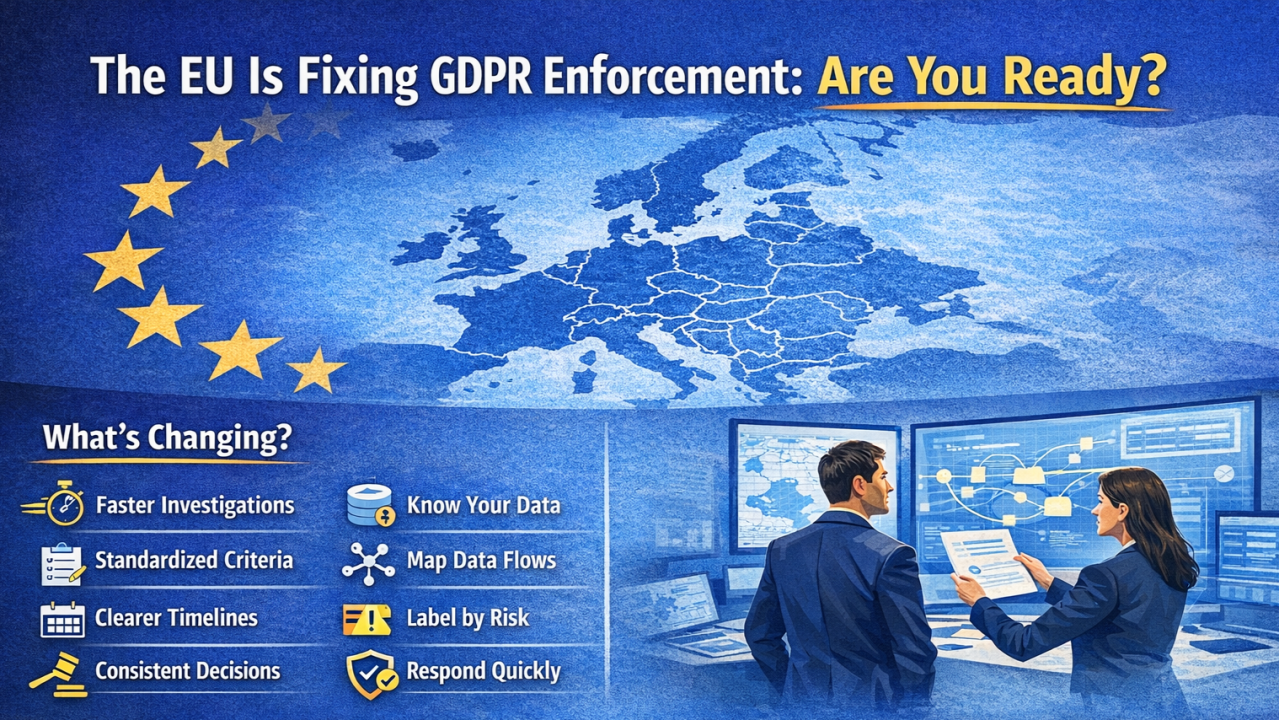
After years of complaints about slow, fragmented GDPR enforcement, Brussels is finally moving.
The Council of the EU and the European Parliament had agreed on new procedural rules to streamline how national Data Protection Authorities (DPAs) handle cross-border GDPR cases. The goal is simple: faster investigations, clearer timelines, and more predictable outcomes when multiple regulators are involved.
For regulators, this is overdue housekeeping. For companies operating across borders, it’s a quiet warning shot.
What Actually Changed
Under the new framework:
• Admissibility criteria are standardized across member states
• Procedural timelines are clarified, reducing year-long investigations
• Simplified settlements become possible without full cooperation mechanism
• DPAs are nudged toward consistency instead of jurisdictional turf wars
In plain English: Cross-border GDPR cases will move faster, with less room to hide behind complexity or regulatory fragmentation.
If you’re a multinational handling data flows across multiple EU countries, this should immediately raise one question:
Do we actually know what data we move, where it goes, and under which legal basis?
Faster Enforcement Exposes Old Weaknesses
For years, many companies relied—consciously or not—on enforcement friction:
• Multiple DPAs involved
• Unclear lead authority
• Procedural deadlocks
• Years before any meaningful outcome
That buffer is shrinking.
When enforcement accelerates, organizational uncertainty becomes regulatory risk:
• Inconsistent data mapping
• Vague transfer justifications
• Manual compliance narratives assembled under pressure
• “We think this dataset is low risk” explanations that don’t scale
Under a faster regime, you won’t have time to reconstruct reality after the fact.
The New Compliance Bottleneck: Data Visibility
The reforms don’t change GDPR substance.
They change how quickly authorities will expect answers.
That shifts the real bottleneck inside companies from legal interpretation to operational clarity.
Multinational teams now need to:
• Know what categories of data they process
• Understand where data physically and legally travels
• Identify which regulations apply per dataset, not per company
• Explain this consistently across jurisdictions
This is where most compliance programs quietly break. Regulators increasingly ask for evidence.
Why Data Labeling Is No Longer “Nice to Have”
Labeling data—by sensitivity, origin, purpose, transfer mechanism, and regulatory exposure—used to be seen as overkill.
Under faster, standardized enforcement, it becomes an efficient tool:
• Faster internal investigations
• Cleaner regulator interactions
• Lower reliance on emergency legal triage
• Consistent answers across DPAs
When data is labeled properly, compliance teams stop firefighting and start managing.
When it isn’t, every inquiry becomes a bespoke, stressful reconstruction exercise.
A Subtle but Important Shift in Regulatory Expectations
The EU’s message is not just “we’ll enforce faster.”
It is that organizations should already be able to explain their data flows clearly.
This aligns with a broader trend we’re seeing globally—from GDPR to China’s data export rules to emerging “digital sovereignty” frameworks:
Data is no longer abstract. It is a governed asset.
And assets are expected to be inventoried, classified, and monitored.
Final Thoughts
These procedural reforms won’t make headlines like new fines or landmark judgments.
But operationally, they may be more impactful.
Companies that treat compliance as documentation will struggle.
Companies that treat compliance as data intelligence will move faster—just like regulators now expect them to.
If your team is still relying on spreadsheets, interviews, and best-effort documentation to explain cross-border data flows, this regulatory shift is the moment to reassess.
Ask yourself:
Do we know our data, or do we assume we do?
Could we answer a cross-border inquiry in weeks, not months?
Some companies are already moving toward data-level visibility:
Automatically identifying which datasets are subject to which regulations
Labeling data by jurisdiction, sensitivity, and transfer risk
Generating regulator-ready views without rebuilding the story each time
That’s exactly the operational gap we built S8FE.AI to address.
If you’re curious what regulatory-ready data visibility looks like in practice—and whether your current setup would hold up under faster, standardized GDPR enforcement—we’re happy to walk through it in a short, no-pressure demo.
Think of it less as a product walkthrough, more as a stress test for your cross-border compliance posture.